When a high-speed rotary tablet press or powder compaction line starts acting up, the first reaction on the plant floor is almost always to blame the powder blend or room humidity.
The symptoms are frustratingly familiar to every tooling tech and line supervisor:
- Capping and Lamination: The top of the tablet fractures or pops completely off during ejection.
- Die Wall Sticking: Granulation clings to the cavity surfaces, pulling material away from tablet faces and leaving rough, pitted bands.
- Weight Drift and High Ejection Loads: Individual tablet weights drift outside validated limits, and press monitors trigger high ejection-force alarms.
Operators often respond by slowing the turret speed, adjusting feeder paddles, changing lubrication spray rates, or swapping punch sets. These tweaks might buy a few clean minutes, but the flaws soon return.
The root cause is rarely the formulation. More often, the real culprit is hidden out of plain sight inside the internal diameter (ID) of the die cavity.
Under dynamic compression forces of 10 to 40 kilonewtons, dry powders and active ingredients act like fine-grit sandpaper. Over millions of strokes, abrasive friction carves microscopic damage into standard die steels. Once that bore geometry degrades, quality issues become inevitable.
What Actually Happens Inside the Die Cavity
To eliminate capping, sticking, and weight variations, we have to examine the mechanical forces that occur in the split second of compression:
The Compression “Wear Ring”
When upper and lower punches compress granulation into a solid tablet, radial pressure forces the powder outward against the die wall.
Even hardened steel yields under this repeated pounding. Over continuous production runs, this outward thrust erodes a microscopic groove—known in the tooling industry as a wear ring or compaction belly—directly at the depth where the tablet forms.
The Upstroke Expansion Trap
When a tablet forms inside that wear ring, it fits the expanded pocket perfectly while under compression. But to eject the tablet, the lower punch must push it upward out of the die table.
As the tablet moves out of the wear ring, it enters the unworn, narrower bore section immediately above it. Because freshly compacted tablets expand slightly (known as elastic recovery), the tablet hits that narrower constriction. The resulting lateral pinch shears the upper perimeter of the tablet, popping the crown off. That is textbook capping.
Micro-Galling and Wall Drag
Dry powders generate substantial sliding friction against bare metal cavity walls. Without continuous lubrication, dry abrasive particulates weld microscopically to steel bore surfaces under heat and pressure.
This micro-galling scores the sides of the passing tablet, creating drag that spikes ejection forces. The higher the ejection force, the more strain is placed on lower punch heads, cam tracks, and press drive motors.
Why Tungsten Carbide Outperforms Standard Tool Steels
Many rotary presses arrive equipped with standard D2, A2, or S7 tool steel dies. While tool steel is cost-effective up front, abrasive formulations and ceramic powders rapidly wear it down.
Tungsten carbide delivers up to 10 times the wear life of premium hardened tool steels:
Solid Carbide vs. Carbide-Lined Dies
- Solid Carbide Dies: Best suited for smaller diameters, high-wear nutraceuticals, and high-tonnage industrial compaction. Solid carbide provides maximum structural rigidity and ensures zero bore expansion during pressing.
- Carbide-Lined Steel Dies: For larger tablet geometries or presses subject to mechanical shock, pressing a precision-ground tungsten carbide liner into a heat-treated tool steel outer holder delivers the ideal combination. The carbide sleeve provides extreme abrasion resistance, while the steel jacket absorbs shock and prevents tool fractures.
Metallic Binder Selection: Cobalt vs. Nickel
Not all wear is purely mechanical. Many pharmaceutical formulations, effervescent products, and chemical compounds contain acidic or corrosive active ingredients.
- Cobalt Binders: Cobalt is the standard binder for tungsten carbide and provides high impact toughness. However, acidic granules can leach cobalt out of the carbide matrix, leaving unsupported grains that wash away under friction.
- Nickel Binders: When running corrosive powders or high-humidity formulations, specifying a nickel-bonded tungsten carbide grade prevents chemical leaching, keeping the die cavity smooth and chemically inert across millions of strokes.
The Grinding Discipline: Sub-Tenths and Mirror ID Finishes
Simply upgrading raw material from tool steel to tungsten carbide is not enough. Conventional cutting tools cannot machine sintered carbide; it demands specialized multi-axis CNC internal grinding and micro-finishing.
Sub-0.0001″ Bore Geometry and Zero Taper
If a die bore is out of round by even one-tenth of a thousandth of an inch (0.0001″), powder compacts unevenly. That creates density variations across the tablet body. When the tablet exits the die, uneven internal stresses cause edge chipping, splitting, or laminating.
Precision CNC internal grinding guarantees the bore remains perfectly concentric, cylindrical, and straight from top to bottom.
Single-Digit Ra Mirror Finishes
Grinding wheels leave microscopic scratch patterns known as lay lines. Abrasive powders pack tightly into those micro-grooves, creating friction points where formulations stick and drag.
Micro-honing and polishing the inner cavity down to a mirror finish (single-digit Ra) removes all grinding marks. A mirror-smooth carbide wall gives granulation zero mechanical grip, ensuring clean tablet ejection and sharp, unblemished tablet faces.
Temperature-Controlled Refrigerated Flood Cooling
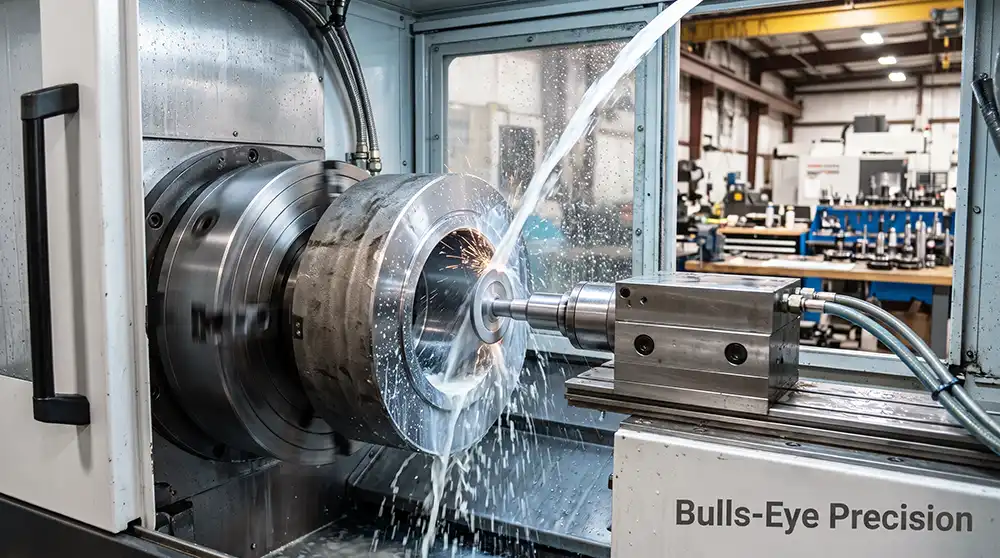
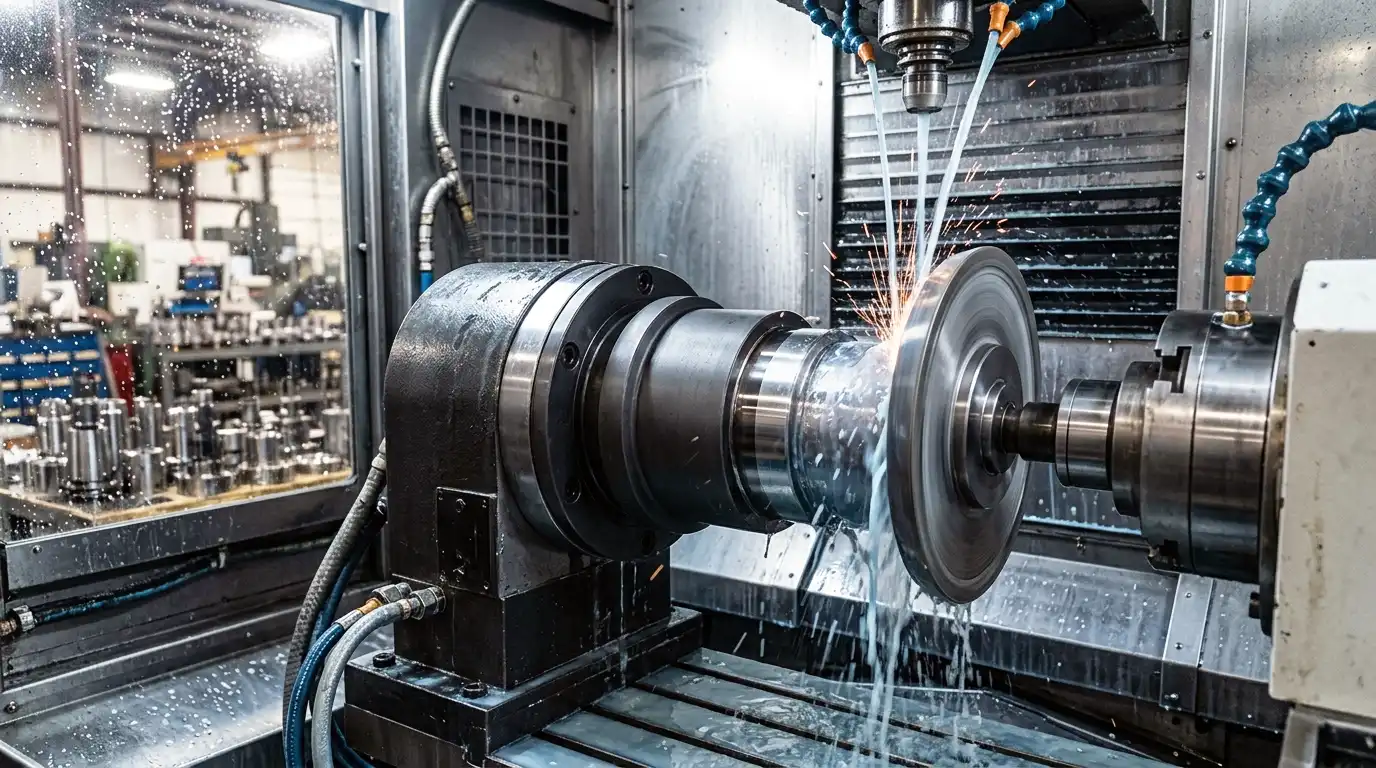
Tungsten carbide is extremely sensitive to thermal shock. Aggressive or dry grinding spikes localized temperatures past 1,200°F. Because the metallic binder expands at a faster rate than the carbide grains, thermal spikes create sub-surface micro-cracks known as thermal checking.
Under operational compaction loads, these invisible cracks can cause a die to split in half. Utilizing high-volume, refrigerated flood coolant during the grinding process whisks heat away instantly, preserving the metallurgical integrity of the carbide.
4 Practical Toolroom Tips to Catch Die Wear Early
Catching internal bore wear before it ruins an entire production batch saves thousands of dollars in rejected product and unplanned downtime:
- Monitor Ejection Force Trends on Press Telemetry: Modern tablet presses track ejection force in real time. If baseline ejection forces on a specific station creep upward over three consecutive shifts, pull that die. A rise in ejection load is the earliest indicator that a wear ring or micro-galling has begun forming.
- Use Precision Air Gages Instead of Calipers: Dial calipers or three-point bore micrometers can easily bridge right over a narrow wear ring. Use pneumatic air gaging to measure the bore diameter along the full stroke depth. An air gage measures airflow clearance and will instantly expose out-of-roundness, taper, or barrel wear down to 0.00005″.
- Inspect the Compression Band with a Boroscope: When a die is pulled for cleaning, inspect the bore under magnification. A dull, frosted band at the compression line indicates that abrasive powder has stripped the polished finish and started cutting into the base metal.
- Implement a Dedicated Die Rotation Schedule: For shaped tablets (ovals, caplets, multi-tips), always record which die stations see the highest tonnage. Rotating and re-qualifying tooling on a planned stroke-count schedule prevents localized press table wear and keeps tablet weights uniform.
Reconditioning vs. Replacement: Cutting Costs and Lead Times
When an internal bore shows wear, plant maintenance teams often assume the die must be scrapped and replaced. In reality, precision grinding shops can often restore worn tooling back to certified drawing specifications:
- ID Re-Lapping and Honing: If wear ring depth is minor and dimensional tolerances allow, an internal lap and micro-polish can clean up the bore surface, restoring mirror finishes without altering nominal tablet dimensions.
- Re-Boring and Re-Sleeving: For steel dies with carbide inserts, worn liners can often be pressed out, allowing the outer steel holder to be fitted with a brand-new, direct-to-print carbide sleeve at a fraction of the cost of a complete replacement assembly.
- Bypassing 16-Week OEM Lead Times: Sourcing replacement tooling from foreign press manufacturers frequently means enduring 12- to 16-week lead times. Working with an agile domestic grinding shop in Michigan allows maintenance teams to fabricate replacement dies, custom punches, and wear parts directly from CAD files and 2D prints in a fraction of that time.
Protect Your Tablet Quality and Toolroom Bottom Line
Die bore wear does not have to be an accepted cost of high-volume powder compaction. By combining wear-resistant tungsten carbide grades with sub-0.0001″ internal CNC grinding and mirror polishing, manufacturing plants can eliminate capping, stop sticking, and maintain tight weight control across every run.
Whether you need to recondition worn compaction tooling or source custom replacement dies built direct-to-print, our team in Buckley, MI is ready to assist.
Explore our precision tooling capabilities on our Carbide Tooling page, or head over to our contact page to submit a drawing for an immediate review and quote.